![[LOGO]](/template/default/img/logo.png)
![[LOGO]](/template/default/img/logo1.png)


![[x]](/template/default/img/closeicon1.png)

Products center
Phone:+86 195-1592-9205
Mail:sales@comfiermed.com
Low-temperature Plasma Technology
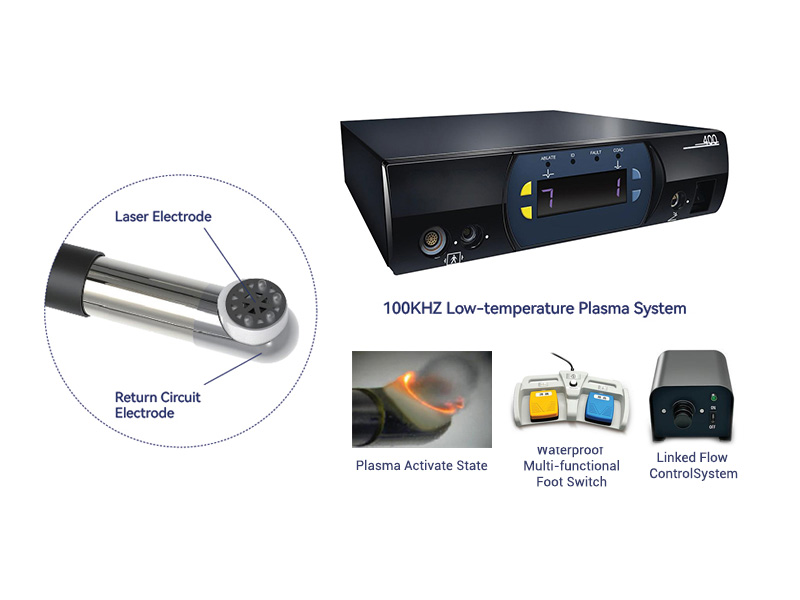
A:Laser Electrode
B:Return Circuit Electrode
The electrode adopts a bipolar design of positive and negative poles. The current only forms a circuit at the electrode head and does not pass through the human body, so there is no need to use a negative plate. The plasma host is equipped with an automatic stop function when the electrode touches the metal to prevent accidental damage to related medical equipment.
Low-temperature Plasma System
Linked Flow Control System
Waterproof Multi-functional Foot Switch
Low-temperature Plasma Technology Principle
Unlike traditional electrosurgery, its principle is to excite sodium ions in physiological saline (electrolyte) through an energy electric field, generating an ionized plasma layer between the two poles of the surgical electrode. This highly excited plasma will rapidly break the lipid bond between tissues, thereby achieving the purpose of cutting and ablation.
Due to the extremely short range of action of the accelerated ions within the plasma thin layer, which is only 100 micrometers, the ablation effect can be precisely controlled on the surface of the tissue in contact with the electrode, having no impact on the deep tissues. Therefore, the damage to the wound surface is very small. Because the electric field only exists between the two poles of the electrode and does not penetrate deep into the tissue, this enables the knife head to precisely control the energy, achieving the effect of tissue decomposition at a low temperature of "40-70℃" and minimizing thermal damage (the working temperature of other electrosurgical operations is between 350-700℃). Low-temperature plasma technology can also cause collagen to shrink, thus achieving the effect of hemostasis while ablation.
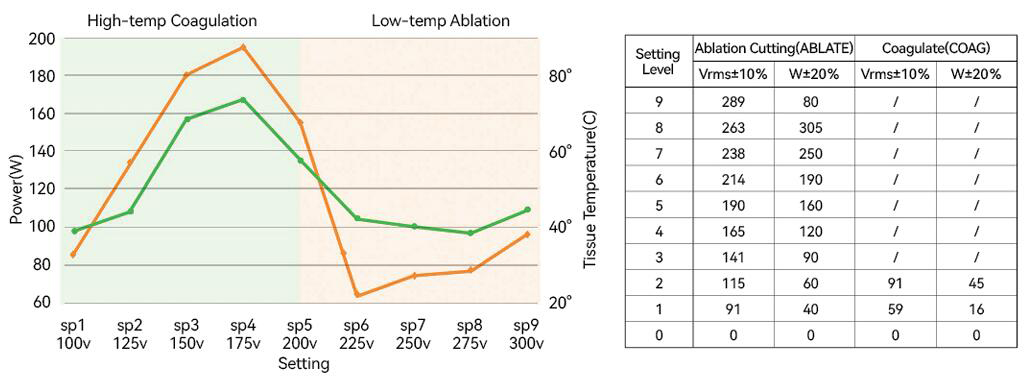
Coagulate/Ablation Mode
By adjusting the setting, the intensity of the plasma can be controlled and different working modes can be switched.
Ablation Cutting:0-9 Setting
Coagulate:0-2 Setting